Skip to content

Platform development diary

Announcements
9 1 2.6k 1
  • Hello !

    Welcome to Sudonix, an exciting new community designed for technical newbies and experts alike. We’re still “moving in” so to speak, and the platform is still being actively developed. Why not take a look around at what’s on offer, and create yourself an account ?

    We’ll keep adding to this post as new features etc are added.

    Don’t be shy 🙂

  • Hello !

    Welcome to Sudonix, an exciting new community designed for technical newbies and experts alike. We’re still “moving in” so to speak, and the platform is still being actively developed. Why not take a look around at what’s on offer, and create yourself an account ?

    We’ll keep adding to this post as new features etc are added.

    Don’t be shy 🙂

    With most of the theming requirements out of the way, we’ve started work on the registration, login, and password reset forms. In the registration forms, we’ve included integration with StopForumSpam, The Honeypot Project, and hCaptcha. Given that Google is a little too light on the privacy side of things, we won’t be using ReCaptcha anytime soon, as it feels wrong to take this route when the founder himself is a huge privacy advocate.

    We were looking at a simple math equation to solve as part of the registration process, but after review, we didn’t feel as though this was adequate in terms of keeping the bad guys on the right side of the door.

    Next up is the terms of service, privacy policy, and everything else asking those lines.

  • I decided from the outset that I wanted to use FA pro on this new site, as I have a subscription, and the icons are better in terms of availability - you get access to a great deal more with a paid plan, and this also means I can use the lighter icons. However, this does mean that some of the icons have had to be replaced with never equivalents. This isn’t an issue as such, but the missing icons are difficult to pin point as they are hidden in drop down menus etc.

    I think I’ve managed to track down all of the icon issues now, but if any seem missing, let me know.

    I also created a few more pages (static) and will be working on the FAQ and policies over the coming days.

  • I decided to enable nginx level caching today, meaning that the backend only needs to contend with the API and not have to worry about serving actual requests (unless they involve the API). In doing so, I totally screwed the registration function on this platform, and it took me a good few hours to troubleshoot and fix 🤭

    Ultimately, the issue was being caused by an incorrect proxy request being sent as http when it should have been https. In addition, policies etc have been added, and I’m working on a FAQ section which will be up in the coming days.

    And b****r… I forgot to add the mobile CSS classes to one of the pages meaning it looks terrible. Need to put that right over the weekend I think 😡

    As a side note, registrations and login work perfectly, so go ahead and get yourself an account. Trust me, when I’m finished, you’ll see why what I’m doing is well worth it.

  • Been a productive day ! I’ve established breadcrumb paths where they were not present, and also fixed a raft of CSS issues between full sized desktops and mobile devices. Very soon (In the coming days) I’ll be adding support for Google and GitHub authentication. LinkedIn support will follow suit, but there are some parts of this particular code that do not work correctly, and will need refactoring.

    I’ve also started work on the dark mode setting meaning that you’ll be able to toggle this setting depending on your preference. The dark theme itself is a bit of a moving target in the sense that is not finished, but this will happen over the coming days.

  • Another big update today in the form of templates. Not much to see on the site itself, but under the hood there are several enhancements. We’ve also added support for Google Auth and will be adding GitHub and LinkedIn support in the coming weeks.

    The breadcrumbs within topics on mobile devices needs a bit of work, and it may be the case we remove these in this view altogether from the mobile view (or perhaps simplify them).

    We are also going to be adding 2fa support in the coming days.

  • More CSS theming today. Spent some time unifying the various pages of the platform towards a central approach. The journey page has also been made mobile friendly (only in dark mode for the moment as this took much longer than I expected) - I’ll extend this to light mode over the coming days. I also noticed a bug on the policies page where light colours are being preferred even in dark mode, so need to fix that also.

  • Some small cosmetic changes recently which make all the difference. In addition to the “Author” tag, there is now also user ranks 🙂

    2c96aefe-1551-45e9-ae88-76a337824297-image.png

    I also modified the groups somewhat so that the badges are radial, and overlap each other (admittedly, an idea I stole from Flarum)

  • It’s been a while since I checked in here. Plenty going on - mostly around rectifying small pockets of resistance between light and dark modes, plus the addition of new features such as an enhanced reputation system and the ability to create polls. Plus, there are several changes going on under the hood which are completely transparent to users or the operation of the platform.

    However, some changes mean that the platform does need to be restarted for code changes to stick and function correctly. I tend to do this during non busy periods, but sometimes, it’s unfortunately inevitable. The good news is that in most cases, a full restart takes only 20 seconds.

    More to come


Related Topics
  • ANNOUNCEMENT: Social Login Changes

    Announcements openid oauth
    4
    1
    6 Votes
    4 Posts
    2k Views
    @DownPW Always looking for ways to improve the overall experience.
  • ANNOUCEMENT: New NTFY Server

    Announcements ntfy push alerts
    9
    1
    7 Votes
    9 Posts
    2k Views
    @crazycells that’s as good a test as any
  • 50 moments in 50 years

    Blog sky nostalgia technology
    3
    2 Votes
    3 Posts
    1k Views
    @DownPW If you don’t mind a retro display type of Dot Matrix - why on earth would anyone want that? I get the concept, but it’s nothing more than a gimmick and adds zero value to the operation of the handset. Sustainable product… with a £600 plus price tag… “Nothing Phone”? More like “Nothing Special”
  • 36 Votes
    46 Posts
    14k Views
    OGProxy : Other Memory Saturation Root Cause & Fix OGProxy was periodically saturating server RAM and swap (up to ~4 GB of arrayBuffers, swap fully consumed), causing multi-minute service degradation. After tracing through several misleading leads, the root cause was identified: OGProxy was downloading entire file-host link bodies into memory when trying to generate previews. On a file-sharing forum, links to file hosts (1fichier, etc.) are everywhere. When OGProxy received a URL like https://1fichier.com/?xxxx, it attempted to “preview” it, but that URL is a direct file download (Content-Type: application/octet-stream, Content-Length: 20.6 GB). OGProxy pulled the file into memory. Critically, neither open-graph-scraper’s downloadLimit nor an AbortController stopped this, verified by reproduction: arrayBuffers climbed ~120 MB/s past 4 GB while the abort timeout was ignored. Diagnostic path (for reference) We instrumented the process with a /debug/mem endpoint exposing process.memoryUsage() + cache size, plus a 30-second sampling trace. This let us correlate memory spikes with nginx access logs. The trace showed arrayBuffers jumping from 0 → 457 → 3669 MB in ~5 minutes, correlated via nginx log to a single GET on a 1fichier link. The cache, EventEmitter listeners, and image links were all ruled out as primary causes (cache stayed at <30 entries during the spike; heapUsed stayed low; only arrayBuffers leaked). A representative slice of the trace at the moment of the spike: 11:24:39 arrayBuffers=0 rss=161 11:25:09 arrayBuffers=457 rss=427 <- jump in one 30s sample 11:25:39 arrayBuffers=884 11:26:09 arrayBuffers=1437 ... 11:30:09 arrayBuffers=3669 No OGProxy fail log line appeared during the spike window, the offending request neither failed nor completed; it was an in-progress, never-ending download. The nginx access log for that minute pointed at the 1fichier GET. Root cause open-graph-scraper (ogs) performs its own internal fetch, and for these URLs: The downloadLimit option does not reliably abort the body download on streamed / chunked responses or on hosts that serve large application/octet-stream payloads. An AbortController passed via fetchOptions.signal does not propagate to the underlying stream read in a way that stops the transfer in time. Result: a single large file-host link could pull multiple GB into arrayBuffers before anything intervened. The fix: bounded streaming fetch The structural problem is that ogs() controls the fetch and we don’t control body consumption. The fix moves the fetch into our own code so we control every byte read: boundedFetch(url, maxBytes, timeoutMs) performs the HTTP fetch itself, then: Re-checks the final host for SSRF after redirects. Rejects any non-text/html / application/xhtml Content-Type before reading the body (aborts immediately). Reads the body chunk-by-chunk via resp.body.getReader(), tracking total bytes, and hard-aborts at 5 MB regardless of what the server claims. The retrieved HTML is then handed to ogs for parsing only: ogs({ html }). This makes the protection structural rather than cooperative: no file host can leak memory regardless of whether it honors HEAD, serves chunked, or misreports headers. Important ogs constraint You must call ogs({ html }) alone. Passing { html, url } together throws: Must specify either `url` or `html`, not both Because url is omitted, ogs cannot resolve relative og:image paths. This is fine here: the ACP client already resolves relative image paths itself (isFullPath() + host + imageUrl), so no client-side change was required. Other hardening applied in the same pass Cache: replaced memory-cache (which creates a per-entry setTimeout that retains the cached object, a secondary leak) with a plain Map using lazy expiry + a single sweep interval. Stored value is slimmed via slimResult(): only error + result + HTML truncated at </head> (preserves <title>, drops the multi-MB body and the undici response object). Cap 300 entries, 30 min TTL, 10 min negative-cache TTL. Negative cache: failed/rejected URLs are cached to prevent re-scrape hammering from the client. SSRF guards (three layers): static host/IP blocklist (private ranges, loopback, link-local, CGNAT, IPv6 ULA/link-local), DNS resolution check, and post-redirect re-validation of the final host. (Also backed at the OS level by systemd IPAddressDeny on the unit.) AbortController + clearTimeout in finally to stop the earlier MaxListenersExceededWarning listener leak on timed-out requests. nginx rate limit: limit_req_zone (10 r/s, burst 50, nodelay, returns 429) on the /ogproxy location. The API key is necessarily exposed client-side (it ships in the ACP JS), so it provides no real protection on its own; the rate limit is the actual abuse mitigation. systemd guard rail: MemoryMax=512M / MemoryHigh=400M so OGProxy can never take the whole box down again, this was the silent hero that kept the server alive throughout diagnosis. Validation Test URL Expected Result https://1fichier.com/?xxxx (20.6 GB) reject, no body read 415, arrayBuffers stays 0 Direct image (pbs.twimg.com/...jpg) reject on content-type 415 https://github.com full preview 200, OG title/image/description, HTML truncated at </head> Process idles at ~100 MB RSS; under load heapUsed oscillates and returns to baseline (no step-up accumulation). Reproduction of the bounded fetch against the 20.6 GB link, confirming zero body is pulled: arrayBuffers AVANT: 0 MB pendant: 0 MB Resultat 1fichier: REJETE: non-HTML content-type: application/octet-stream arrayBuffers APRES: 0 MB Note on dependencies Reproduced on open-graph-scraper 6.1.0 / undici 5.22.1 / Node 24. The unreliable downloadLimit behavior may be version-specific; a newer undici might handle aborts on large streams better. The bounded-fetch approach is robust regardless of the underlying library version, so it is the recommended long-term fix. Appendix A: Full server.js const express = require('express'); const ogs = require('open-graph-scraper'); const cors = require('cors'); const { URL } = require('url'); const dns = require('dns').promises; const net = require('net'); require('events').EventEmitter.defaultMaxListeners = 50; const app = express(); const port = 2000; const apiKey = process.env.OGPROXY_API_KEY || '<API_KEY>'; const REQUEST_TIMEOUT = 12000; const MAX_CONTENT_BYTES = 5 * 1024 * 1024; // 5 MB hard cap on body const CACHE_TTL_MS = 30 * 60 * 1000; const FAIL_CACHE_TTL_MS = 10 * 60 * 1000; const CACHE_MAX_ENTRIES = 300; const MAX_REDIRECTS = 3; // --- Map cache (lazy expiry, no per-entry timers) --- const cacheStore = new Map(); function cacheGet(key) { const e = cacheStore.get(key); if (!e) return null; if (Date.now() > e.expires) { cacheStore.delete(key); return null; } return e.value; } function cacheSet(key, value, ttl) { if (cacheStore.size >= CACHE_MAX_ENTRIES) { cacheStore.delete(cacheStore.keys().next().value); } cacheStore.set(key, { value, expires: Date.now() + ttl }); } setInterval(() => { const now = Date.now(); for (const [k, e] of cacheStore) if (now > e.expires) cacheStore.delete(k); }, 60 * 1000).unref(); function slimResult(results) { if (!results || typeof results !== 'object') return results; let slimHtml = ''; if (typeof results.html === 'string') { const headEnd = results.html.search(/<\/head>/i); slimHtml = headEnd !== -1 ? results.html.slice(0, headEnd + 7) : results.html.slice(0, 8192); } return { error: results.error, result: results.result, html: slimHtml }; } function isBlockedIp(ip) { if (!ip) return true; if (net.isIPv4(ip)) { const p = ip.split('.').map(Number); if (p[0] === 10) return true; if (p[0] === 127) return true; if (p[0] === 0) return true; if (p[0] === 169 && p[1] === 254) return true; if (p[0] === 192 && p[1] === 168) return true; if (p[0] === 172 && p[1] >= 16 && p[1] <= 31) return true; if (p[0] === 100 && p[1] >= 64 && p[1] <= 127) return true; return false; } if (net.isIPv6(ip)) { const v = ip.toLowerCase(); if (v === '::1') return true; if (v.startsWith('fc') || v.startsWith('fd')) return true; if (v.startsWith('fe80')) return true; if (v.startsWith('::ffff:')) return isBlockedIp(v.split(':').pop()); return false; } return true; } function isBlockedHost(hostname) { if (!hostname) return true; const h = hostname.toLowerCase(); return ( h === 'localhost' || h.endsWith('.localhost') || h.endsWith('.internal') || h.endsWith('.local') || (net.isIP(h) && isBlockedIp(h)) ); } async function resolvesToPublicIp(hostname) { try { const records = await dns.lookup(hostname, { all: true }); if (!records || records.length === 0) return false; return records.every(r => !isBlockedIp(r.address)); } catch (e) { return false; } } // Bounded streaming fetch: reads the body chunk by chunk and aborts hard at maxBytes. // Rejects non-HTML content-types before reading any body. Structural protection // against file hosts (1fichier, etc.) - independent of what the server claims. async function boundedFetch(url, maxBytes, timeoutMs) { const controller = new AbortController(); const timer = setTimeout(() => controller.abort(), timeoutMs); try { const resp = await fetch(url, { redirect: 'follow', signal: controller.signal, headers: { 'User-Agent': 'Mozilla/5.0 (Windows NT 10.0; Win64; x64) AppleWebKit/537.36 (KHTML, like Gecko) Chrome/126.0.0.0 Safari/537.36', 'Accept': 'text/html,application/xhtml+xml,application/xml;q=0.9,image/avif,image/webp,*/*;q=0.8', 'Accept-Language': 'fr-FR,fr;q=0.9,en;q=0.8', }, }); // Re-check final host after redirects (anti-SSRF) try { const finalHost = new URL(resp.url || url).hostname; if (isBlockedHost(finalHost) || !(await resolvesToPublicIp(finalHost))) { controller.abort(); return { ok: false, reason: 'redirect to forbidden host' }; } } catch (e) { /* ignore */ } const ctype = (resp.headers.get('content-type') || '').toLowerCase(); if (ctype && !ctype.includes('text/html') && !ctype.includes('application/xhtml')) { controller.abort(); // not HTML: read nothing return { ok: false, reason: `non-HTML content-type: ${ctype.split(';')[0]}` }; } if (!resp.body) { return { ok: false, reason: 'no response body' }; } const reader = resp.body.getReader(); const chunks = []; let total = 0; while (true) { const { done, value } = await reader.read(); if (done) break; total += value.length; if (total > maxBytes) { controller.abort(); // hard cap reached: stop downloading return { ok: false, reason: `body exceeded ${maxBytes} bytes` }; } chunks.push(value); } const html = Buffer.concat(chunks).toString('utf8'); return { ok: true, html }; } catch (e) { return { ok: false, reason: (e && e.name === 'AbortError') ? 'timeout/abort' : (e && e.message) || 'fetch error' }; } finally { clearTimeout(timer); } } app.use(cors({ origin: 'https://YOUR_DOMAIN.EXT' })); app.get('/debug/mem', (req, res) => { const m = process.memoryUsage(); res.json({ rss_mb: Math.round(m.rss / 1048576), heapUsed_mb: Math.round(m.heapUsed / 1048576), external_mb: Math.round(m.external / 1048576), arrayBuffers_mb: Math.round(m.arrayBuffers / 1048576), cache_entries: cacheStore.size, }); }); app.get('/ogproxy', async (req, res) => { let { url } = req.query; const requestApiKey = req.headers['x-api-key']; if (requestApiKey !== apiKey) return res.status(401).send('Unauthorized'); if (!url || typeof url !== 'string') return res.status(400).send('Missing URL parameter'); if (!url.startsWith('http')) { try { url = new URL(url, `${req.protocol}://${req.get('host')}`).href; } catch (e) { return res.status(400).send('Invalid URL'); } } let parsedUrl; try { parsedUrl = new URL(url); } catch (e) { console.warn(`OGProxy reject [${url}]: invalid URL`); return res.status(400).send('Invalid URL'); } if (!['http:', 'https:'].includes(parsedUrl.protocol)) { return res.status(400).send('Invalid protocol'); } if (isBlockedHost(parsedUrl.hostname)) { console.warn(`OGProxy reject [${url}]: forbidden host (static guard)`); return res.status(403).send('Forbidden host'); } const cached = cacheGet(url); if (cached) { if (cached.__ogproxyFail === true) return res.status(500).send('Error scraping Open Graph data (cached)'); return res.json(cached); } if (!(await resolvesToPublicIp(parsedUrl.hostname))) { console.warn(`OGProxy reject [${url}]: resolves to private IP / DNS fail (SSRF)`); cacheSet(url, { __ogproxyFail: true }, FAIL_CACHE_TTL_MS); return res.status(403).send('Forbidden host'); } if (cacheStore.size >= CACHE_MAX_ENTRIES) { cacheStore.delete(cacheStore.keys().next().value); } // Bounded fetch: download the body ourselves, capped at 5 MB, HTML-only. const fetched = await boundedFetch(url, MAX_CONTENT_BYTES, REQUEST_TIMEOUT); if (!fetched.ok) { console.error(`OGProxy reject [${url}]: ${fetched.reason}`); cacheSet(url, { __ogproxyFail: true }, FAIL_CACHE_TTL_MS); const code = (fetched.reason.startsWith('non-HTML') || fetched.reason.startsWith('body exceeded')) ? 415 : 500; return res.status(code).send('Unable to preview this URL'); } try { // Parse the already-fetched HTML (no second fetch). Client resolves relative image paths itself. const results = await ogs({ html: fetched.html }); const slim = slimResult(results); cacheSet(url, slim, CACHE_TTL_MS); return res.json(slim); } catch (error) { const reason = (error && error.result && error.result.error) || (error && error.message) || 'unknown'; console.error(`OGProxy fail [${url}]: ${reason}`); cacheSet(url, { __ogproxyFail: true }, FAIL_CACHE_TTL_MS); return res.status(500).send('Error scraping Open Graph data'); } }); app.listen(port, () => { console.log(`OGProxy server listening on port ${port}`); }); Note: /debug/mem is a temporary diagnostic endpoint. Remove it once the deployment is confirmed stable in production. Appendix B: nginx rate limit Zone definition, placed in /etc/nginx/conf.d/ogproxy-ratelimit.conf (included at the http level; survives vhost regeneration by the panel): # Rate limit zone for OGProxy - 10 MB shared memory (~160k IPs tracked) # 10 requests/second sustained per IP limit_req_zone $binary_remote_addr zone=ogproxy_limit:10m rate=10r/s; Application, inside the reverse-proxy location / of the OGProxy vhost: location / { limit_req zone=ogproxy_limit burst=50 nodelay; limit_req_status 429; proxy_set_header Host $host; proxy_pass http://127.0.0.1:2000; proxy_redirect off; proxy_set_header X-Forwarded-For $proxy_add_x_forwarded_for; proxy_set_header X-Api-Key $http_x_api_key; } burst=50 absorbs the legitimate burst when a user opens a link-heavy topic (the client fires many preview requests at once); sustained hammering beyond that is rejected with 429. Appendix C : systemd unit guard rails Key directives on ogproxy.service: [Service] MemoryHigh=400M MemoryMax=512M Restart=always RestartSec=3 # SSRF egress guard (OS-level backstop to the in-app checks) IPAddressAllow=127.0.0.1 127.0.0.53 127.0.0.54 IPAddressDeny=10.0.0.0/8 172.16.0.0/12 192.168.0.0/16 169.254.0.0/16 100.64.0.0/10 fc00::/7 fe80::/10 127.0.0.1 must stay allowed because nginx reverse-proxies to OGProxy over loopback; blocking all loopback breaks the nginx -> ogproxy hop (504s).
  • Clustering for NodeBB enabled

    Announcements cluster
    22
    1
    16 Votes
    22 Posts
    5k Views
    @Madchatthew True. I think this is the reason as to why most Open Source projects are abandoned because they are not sustainable in the long-term.
  • Testing out Webdock.io

    Moved Announcements webdock recovery speed
    2
    5
    5 Votes
    2 Posts
    1k Views
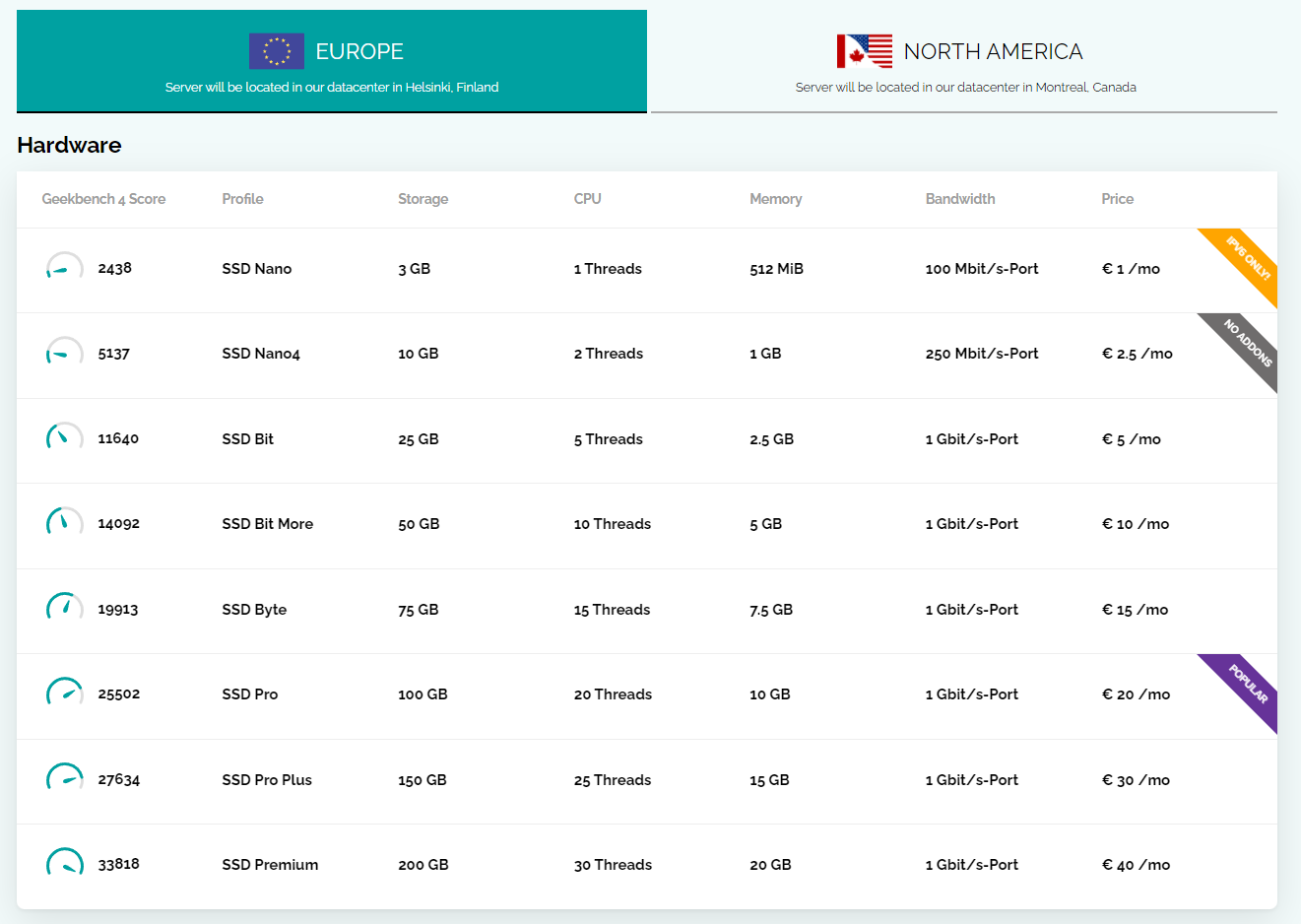
    Just coming back to this thread for review (as I often do), and it looks like Webdock have increased their available offerings - some are extremely powerful, yet very competitive from the pricing perspective. [image: 1692559685163-7cf9a928-ac21-44fe-99c6-90439030d631-image.png] 10 CPU cores, plus 20Gb RAM? Well worth a look (and the asking price) - there’s also a fixed IP which is hugely beneficial. Clearly, this is well beyond what most people will want to spend - it’s more of an example (but interestingly, Sudonix runs on something not too different from the above). However, not all that glitters is gold - just have a walk through the benchmark report I found below and you’ll see a huge difference between Heztner and Webdock https://www.vpsbenchmarks.com/compare/hetzner_vs_webdock That being said, the amount of HTTP requests that Webdock handles in relation to Hetzner is superior - @DownPW you might want to have a look at this - there’s a free 24 hour trial… [image: 1692560710486-5203639b-2f62-47e6-b87b-37580ce5deae-image.png]
  • Fancybox now used for image handling

    Announcements fancybox
    16
    6 Votes
    16 Posts
    4k Views
    And it seems to be less conflicting!
  • what is the reason for choosing node BB over flarum?

    Solved Performance
    21
    11 Votes
    21 Posts
    6k Views
    @jac @Hari my thoughts around this are that with any platform - be that WordPress, Flarum, or NodeBB, there is an inevitable “lock in” - very much like Hotel California (“you can check out any time you like, but you can never leave”). What I mean by this is that you are buying into an ecosystem that offers no easy or readily available path out. If you plan to stay for the long term and there is a clear progression path from that project meaning it’s a viable route, then great. However, all of these platforms (except WordPress perhaps) have a way of ingesting data from other sources, but little to no way at all of taking that data somewhere else. This is nothing against any of those platforms, but the fundamental issue here is that whilst it’s probably easy to move into another product, it’s a different story altogether when you want to leave and take your data with you. Most FOSS based platforms can realise this and make money out of migrations. I know for certain that wpForo does this, and I also know that it’s something that one of the developers at Flarum has been touting for some time.